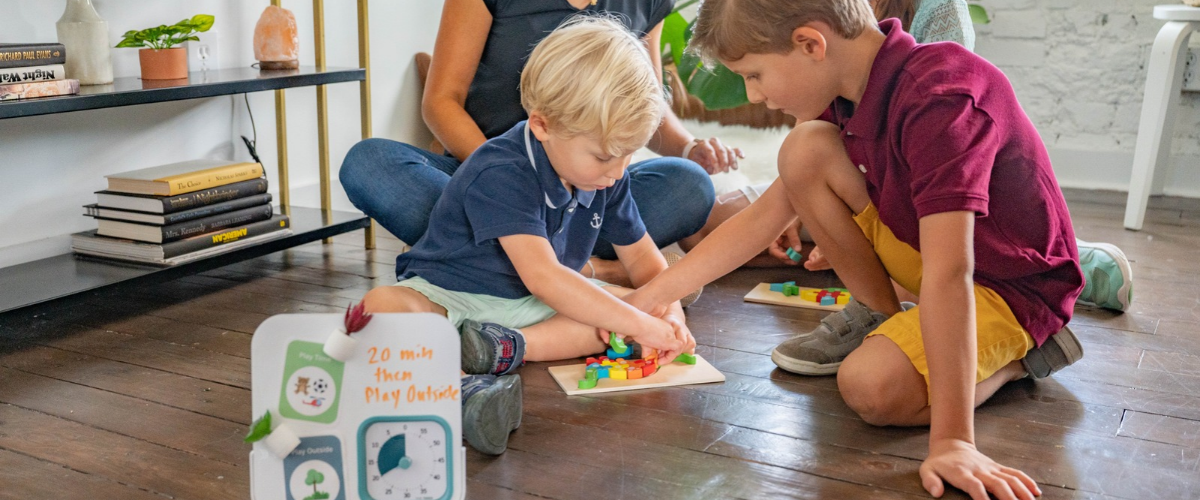


If you've ever thought Montessori was simply a classroom filled with wooden toys and children choosing whatever they want to do all day, you're not alone.
It's one of the biggest misconceptions about Montessori education.
In a recent episode of Rethink Time, we spoke with Montessori educator Anita Calo, who has spent more than 20 years mentoring teachers, supporting families, and helping children thrive through Montessori principles. During our conversation, Anita explained that Montessori isn't a curriculum or a collection of classroom materials, buti an approach built on understanding how children naturally develop.
Whether you're a teacher looking to better support your students or a parent hoping to create calmer routines at home, Montessori offers practical lessons that anyone can apply.
Montessori Begins with Respect
According to Anita, the foundation of Montessori is surprisingly simple:
Respect the child.
That respect shapes every decision, from how adults communicate with children to how classrooms are designed.
In a Montessori environment, furniture is child-sized. Learning materials are accessible. Children are encouraged to make meaningful choices within clear boundaries.
Rather than asking, "How do I get this child to do what I want?" Montessori asks a different question:
"What does this child need in order to succeed?"
That subtle shift changes everything.
The Environment Is the Teacher
One of the most powerful ideas Anita shared is that behavior should rarely be viewed in isolation.
When something isn't working, Montessori encourages adults to look in this order:
- The environment
- The adult
- The child
Instead of immediately correcting behavior, ask:
- Is the space overstimulating?
- Is there too much clutter?
- Is the child hungry, tired, or overwhelmed?
- Am I bringing stress into this interaction?
Often, changing the environment changes the behavior.
For families, this might mean rotating toys instead of leaving everything out. It could mean reducing background noise, dimming lights before bedtime, or simplifying morning routines.
For educators, it may mean creating spaces that encourage independence instead of constant adult direction.
Children Learn Best Through Concrete Experiences
One reason Montessori has remained relevant for more than 100 years is its emphasis on making abstract ideas tangible.
Children don't naturally understand concepts like:
- Time
- Quantity
- Length
- Size
They understand what they can see, touch, carry, and experience.
Montessori materials were intentionally designed to turn abstract concepts into concrete experiences.
As Anita explained, children physically carry materials that demonstrate "big" and "small" or "long" and "short" before they're ever expected to understand those ideas abstractly.
This same principle is why visual timers are so effective.
Why Time Is So Difficult for Children
Time is one of the most abstract concepts children encounter.
When an adult says: "Five more minutes." A young child often has no meaningful reference for what that actually feels like. That's why Anita immediately recognized the value of the Time Timer® when she first saw one in her classroom. By making time visible, the disappearing red disk transforms something invisible into something children can actually understand.
Instead of wondering how long five minutes feels, they can watch time pass.
It's a perfect example of Montessori's belief that children learn best when abstract ideas become concrete.
Independence Doesn't Mean "Anything Goes"
Another common misconception is that Montessori classrooms lack structure. In reality, they provide tremendous freedom, but always within clear limits.
Children choose their work. They decide what to begin with. They move throughout the classroom independently.
But those freedoms exist alongside expectations:
- Respect yourself.
- Respect others.
- Respect the environment.
- Use materials appropriately.
The adult isn't removed from learning. Instead, the adult becomes a careful observer and guide, introducing new challenges when children demonstrate they're ready.
Observation Is One of the Most Powerful Parenting Tools
Perhaps the simplest Montessori strategy anyone can begin using today is observation.
Instead of immediately reacting to challenging behavior, pause and ask:
- What happened just before this?
- What seems to trigger this behavior?
- What is my child trying to communicate?
- Is there something in the environment contributing?
Anita encourages parents to become curious rather than critical.
Sometimes the answers are surprisingly simple.
A tired child.
Too many toys.
Too much noise.
Too many choices.
Observation helps adults respond intentionally instead of react emotionally.
Adults Set the Emotional Tone
One of Anita's favorite Montessori concepts is that adults are the "thermostat" for children. Young children are still developing the ability to regulate their emotions. They often borrow regulation from the adults around them.
When adults slow down, lower their voices, and remain calm, children often begin matching that energy. That doesn't mean children never experience big emotions. It means adults become the steady presence that helps them move through those moments.
Bringing Montessori Home
You don't need a Montessori classroom to begin applying these principles.
Small changes can have a big impact:
- Simplify play spaces.
- Offer limited choices instead of unlimited ones.
- Encourage children to complete tasks independently.
- Create predictable routines.
- Slow down when emotions run high.
- Observe before intervening.
- Make abstract concepts more visual whenever possible.
These practices don't require expensive materials. They simply require seeing children through a different lens.
Final Thoughts
More than a century after Maria Montessori first began observing children, modern neuroscience continues to reinforce many of her discoveries.
Children learn through movement, they thrive when they're respected, they develop confidence through independence, and they understand the world best when abstract ideas become concrete experiences.
Whether you're raising children, teaching a classroom, or supporting neurodivergent learners, Montessori offers practical principles that help children become capable, curious, and confident learners.
Listen to the Full Conversation
Want to hear more from Anita Calo?
Listen to this episode of Rethink Time, where we dive deeper into Montessori philosophy, child development, emotional regulation, and practical strategies families and educators can begin using today.
Subscribe to Rethink Time wherever you get your podcasts.