

For some adults, they feel behind in life even when they’re working hard? For many adults, the answer is not motivation but perception. Their issue is time blindness.
Time blindness refers to difficulty perceiving and managing the passage of time. Time seems to speed up or slow down randomly, making deadlines hard to meet.
What Is Time Blindness?
Time blindness is feature of ADHD and other forms of executive dysfunction. The difficulty sensing how much time has passed or remains is why you can be chronically late despite working hard.
Ignoring the clock, you may not even realize you are running late for a meeting at 2:00.
Anxiety from time blindness comes from the possibility of losing track and missing something important in a task. That dread is why you feel perpetually "behind" no matter how much you accomplish.
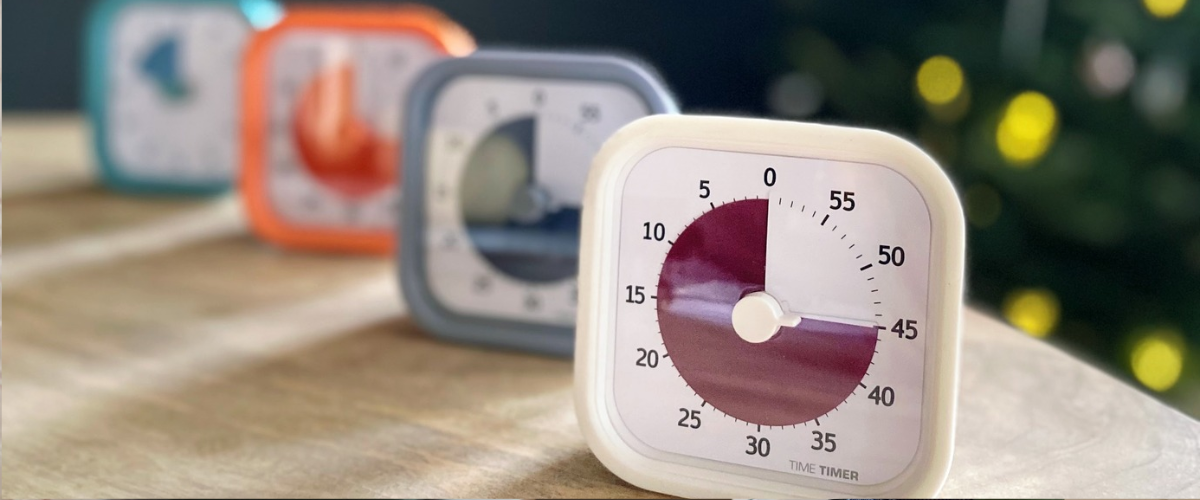
Time blindness is easier to manage with external visual structure, which is what visual timers provide.
The Hyperfocus Trap: When "Now vs. Not Now" Steals Your Day
With time blindness often comes hyperfocus: locking onto an interesting task so completely that time starts slipping.
The brain runs on "now vs. not now": if it's not happening this second, it doesn't feel real. That means there's no internal alarm to pull you out before hours are gone.
The Time Timer® MOD + Dry Erase Board works as a workspace anchor for this exact problem. Set visual blocks where you write the task on the board beside the timer. If you are looking for desk productivity tools for ADHD, Time Timer offers genuinely silent countdown timers for office use. The shrinking disk helps you stay out of hyperfocus before burnout hits.
Stuck in "Waiting Mode"? Why You Can't Start Anything Before an Appointment
“Waiting mode" is a form of task initiation paralysis. You may be asking yourself, “Why do I struggle with task initiation before a deadline that's still hours away?”
Your brain can't safely commit to a new task without a trustworthy sense of how much time is left before it needs to switch gears.
The Time Timer® Original 3" is small enough to sit on a laptop or desk, letting you carve out a visible "safe" work chunk, such as a 60-minute deep-work block you can trust.
ADHD waiting mode tips recommend not trying to “feel” the time: watch time instead. The compact genuinely useful visual timer for adults makes it easy to watch time anywhere.
When a 1-Hour Task Takes 4 Hours: Fixing Project Scope Blindness
Time blindness distorts planning: adults chronically underestimate how long a report, study session, or even chore will take. This makes it easy to feel you are falling behind, because you worked hard the whole time but the task took much longer than predicted.
The Time Timer PLUS® 120-Minute is built to make your project scopes fit within set timespans. Set the timer at the start of a project and focus in for the two-hour window (or less, depending on what you set), checking in when you feel like it to see at what point the elapsing disk is at.
This timer is one of the best visual timers for studying because of the time length. It serves as a practical adult ADHD executive dysfunction strategies available. It turns an abstract two hours into something you can watch happen.
The Invisible Commute: Anchoring Morning Routines to Reality
Getting out the door is a daily trigger for feeling behind. Time blindness makes it easy to forget the "in-between" minutes: finding keys, tying shoes, walking to the car. That’s because those moments may not feel like "real" time.
The Time Timer® Watch puts the same visual disk on the wrist. Support travels through parts of the day a desk timer can't reach. Set visual countdowns for morning routines or commutes for a constant discreet anchor to reality.
As a portable visual watch for adults, it's a clear example of neurodivergent-friendly time management. The support moves with you instead of staying fixed to one room.
Overcoming Time Blindness: Quick Coping Strategies
-
Externalize deadlines with a visible physical timer instead of relying on your internal clock
-
Break big projects into timed 60–120 minute blocks to rebuild an accurate sense of duration
-
Set a "safe zone" timer before appointments instead of sitting in waiting mode
-
Pair a timer with a written task so your brain has both a boundary and a target
-
Practice overcoming productivity guilt by tracking what you actually finish, not just what felt slow
Frequently Asked Questions
What is time blindness? Difficulty sensing the passage of time, common in ADHD and executive dysfunction. It leads to lost hours, chronic lateness, and trouble estimating how long tasks take.
Why do I always feel behind even when I'm working hard? Time blindness distorts perception, not effort. You can work hard the entire time and misjudge how long a task took, creating a persistent feeling of falling short.
How can I stop hyperfocus from making me lose track of time? Set a visual timer before you start so your brain can see time rather than feel.
How to manage time blindness at work? Use a visible silent countdown for both short focus blocks and longer project sessions. Pair it with a written task list so you can see the boundary and goal at once.